You are singing something, a song you know or a tune you made up, and you want to know its key. Maybe a guitarist asked. Maybe you need a backing track, or you are setting up pitch correction, or you just want to check that you and the recording agree.
There are three ways to find out. One takes about fifteen seconds and a phone. The other two use your ears, and are worth learning anyway.
First, what “the key you are singing in” means
A key is a home note plus the set of notes that sound right around it. When you sing a melody, most of your notes come from one such set, and the tune keeps wanting to settle on one of them. That resting note names the key: C, or F sharp, or B flat. The key is also either major or minor, which is roughly the difference between a bright sound and a dark one. Our guide to what a key is has the longer version.
Way 1: sing into a key finder
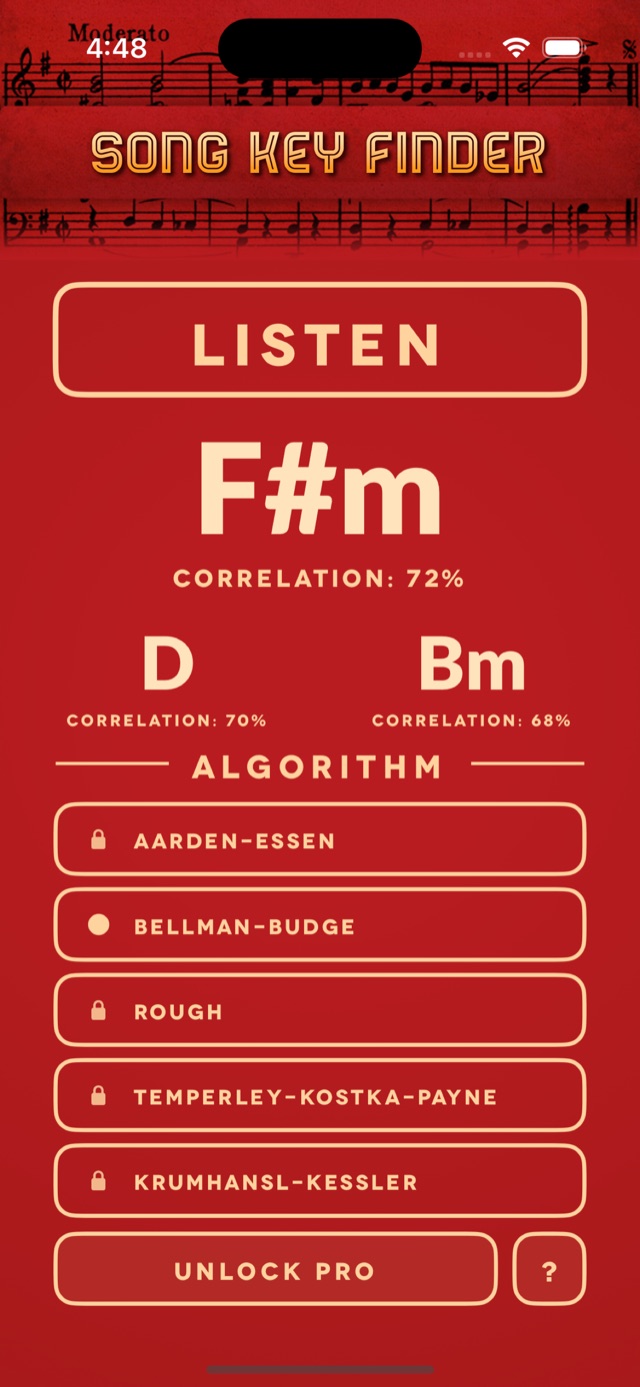
This is the quick way. Our app, Trova Song Key Finder, listens through your phone’s microphone and works out the key from the notes it hears.
- Open the app and press Listen.
- Sing a verse or a chorus at a steady, comfortable volume.
- Read the key at the top of the screen. Two runner-up keys appear below it, each with a score showing how strongly it matches.
- Press Stop.
For the best reading, sing in a quiet room and keep going for a few lines. One clear melody gives it plenty to work with. A short phrase with only three or four different notes doesn’t.


Way 2: find your home note on an instrument
You need a piano, a guitar, or a piano app.
- Sing to the end of the chorus and hold the last note. Most tunes finish on the home note, because that is where a melody sounds complete.
- Find that note on the instrument. Keep singing it while you try keys or frets, one at a time, until one matches.
- Decide between major and minor. Play the major chord built on that note, then the minor chord, while humming the tune. One will fit and the other will sound wrong.
If the note you held was G and the major chord fits, you are singing in G major.
Way 3: hum the home note into a tuner
If you don’t have an instrument, a tuner app will do. Sing the tune, stop, and hum the one note that feels like rest. Hold it steady and read the note name from the tuner. That gives you the home note. A tuner won’t tell you major from minor, but if the song sounds bright and settled it is probably major, and if it sounds dark or sad it is probably minor.
Why the answer might surprise you
- You drifted. Without accompaniment most people slide a little flat or sharp over a verse, and can end up between two keys. Give yourself a starting note from a piano app and try again.
- Major and minor twins. Every major key shares all of its notes with one minor key, called its relative minor. A key finder can’t always tell them apart from a melody alone, which is why Trova shows three answers instead of one.
- You are not in the original key. People often sing a song lower or higher than the recording without noticing. That is fine. The key you are singing in is the one that matters for your accompaniment.
If the key doesn’t suit your voice, move it
Finding the key is half the job. If the high notes strain or the low notes disappear, the song is in the wrong key for you, and you can change it.
- On guitar, a capo raises the key one fret at a time. Our capo chart shows where to put it.
- For any instrument, our guide to transposing a song shows how to move every chord by the same amount.
- Karaoke machines and most backing-track apps have a key control that does the same thing.
- To see what you have to work with, take our two-minute vocal range test.
Singing along with a recording
To check whether you are in the same key as a recording, find the key of each. Play the track near your phone and let Trova listen, then sing the same section without the track and listen again. If the two answers match, you are in the original key, even if you are singing an octave above or below the singer.
Questions and answers
Can an app tell me what key I am singing in?
Yes. A key finder that listens through the microphone, such as Trova Song Key Finder, works out the key from the notes you sing. Sing a few lines of a clear melody in a quiet room for the most reliable result.
How do I find my key without an instrument?
Sing the song, then hum the note that feels like home, usually the last note of the chorus. A tuner app will name that note, and a key finder app will give you the full key, major or minor.
Is it wrong to sing a song in a different key from the original?
No. Singers change keys all the time to fit their range. What matters is that you and your accompaniment are in the same key.
Does singing an octave lower change the key?
No. An octave up or down uses the same note names, so the key stays the same.
What is the best key for my voice?
There isn’t one. The best key is different for every song, because it depends on where that song’s highest and lowest notes fall in your range.
Keep reading
- Vocal range test: find your range in two minutes
- How to transpose a song into your key
- What is a key in music?
Find your key in a few seconds
Trova Song Key Finder is available for iPhone, iPad, and Android. It is a paid app with no subscription and no ads. Learn more about Trova.