When someone says a song is “in the key of G,” they are telling you two things: which note the music treats as home, and which set of notes it is built from. That is all a key is. Almost everything else in music theory starts from that idea.
The short answer
A key is a home note plus a scale built on it. The home note gives the key its letter name. The scale is the family of seven notes that sound right together around that home note. A song in the key of G major uses mostly the notes of the G major scale, and keeps coming back to rest on G.
The home note
Sing “Happy Birthday” and stop one note before the end. It feels unfinished, almost uncomfortable. Sing the last note and everything settles. That last note is the home note, which musicians call the tonic. Music creates tension by moving away from it and release by returning to it.
The scale
There are twelve different notes in Western music. A key picks seven of them. In the key of C major the seven are C, D, E, F, G, A, and B, which are the white keys on a piano. Notes outside the scale can still appear in a song, but they stand out, like a word borrowed from another language.
The same seven notes also give a key its chords. Our chart of the chords in every key lists them all.
Major and minor
Keys come in two main kinds. Major keys tend to sound bright, open, or settled. Minor keys tend to sound darker or more serious. The difference comes from the pattern of steps in the scale, and above all from the third note, which is one semitone lower in a minor key.
So C major and C minor share a home note and feel very different. The key name always has both parts: the note and the kind.
How many keys are there?
Twenty-four. Each of the twelve notes can be the home of a major key and of a minor key. Some have two spellings, such as F# major and Gb major, which sound the same and are written differently.
The keys come in pairs. Every major key shares its seven notes with one minor key, called its relative minor. C major and A minor are one such pair. The chart below shows all twelve pairs, along with the sharps or flats each pair uses.
| Major key | Relative minor | Key signature | Sharps or flats |
|---|---|---|---|
| C major | A minor | None | – |
| G major | E minor | 1 sharp | F# |
| D major | B minor | 2 sharps | F#, C# |
| A major | F# minor | 3 sharps | F#, C#, G# |
| E major | C# minor | 4 sharps | F#, C#, G#, D# |
| B major | G# minor | 5 sharps | F#, C#, G#, D#, A# |
| F# major | D# minor | 6 sharps | F#, C#, G#, D#, A#, E# |
| Db major | Bb minor | 5 flats | Bb, Eb, Ab, Db, Gb |
| Ab major | F minor | 4 flats | Bb, Eb, Ab, Db |
| Eb major | C minor | 3 flats | Bb, Eb, Ab |
| Bb major | G minor | 2 flats | Bb, Eb |
| F major | D minor | 1 flat | Bb |
There is more on how those pairs work in our guide to relative major and minor keys.
Key signatures
In written music, the key is shown at the start of every line as a group of sharps or flats called the key signature. One sharp means G major or E minor. Three flats means Eb major or C minor. It saves writing the same sharp or flat in front of a note every time it appears.
Key, scale, and chord: the difference
- A scale is a set of notes in order, like a ladder.
- A chord is several notes played together.
- A key is the bigger idea that ties them together: a home note, the scale built on it, and the chords built from that scale.
And three things a key is not. It is not the tempo, which is the speed. It is not the pitch of a single note. And it is not the time signature, which is how the beats are counted.
Songs can change key
A song doesn’t have to stay in one key. A change of key is called a modulation. The classic example is the final chorus that suddenly moves up by a semitone or two, which makes the same tune sound bigger. Other songs put the verse in a minor key and the chorus in its relative major.
Why the key matters
- Singers need a key where the highest and lowest notes of the tune fall inside their range. The same song can be easy in one key and impossible in another.
- Guitarists and pianists can predict the chords of a song once they know its key, which makes learning by ear much faster.
- Bands have to agree on a key before anyone plays a note.
- DJs match the keys of tracks so that a blend doesn’t clash, often using the Camelot wheel.
- Producers need the key to tune bass notes and to set up pitch correction.
How to find the key of a song
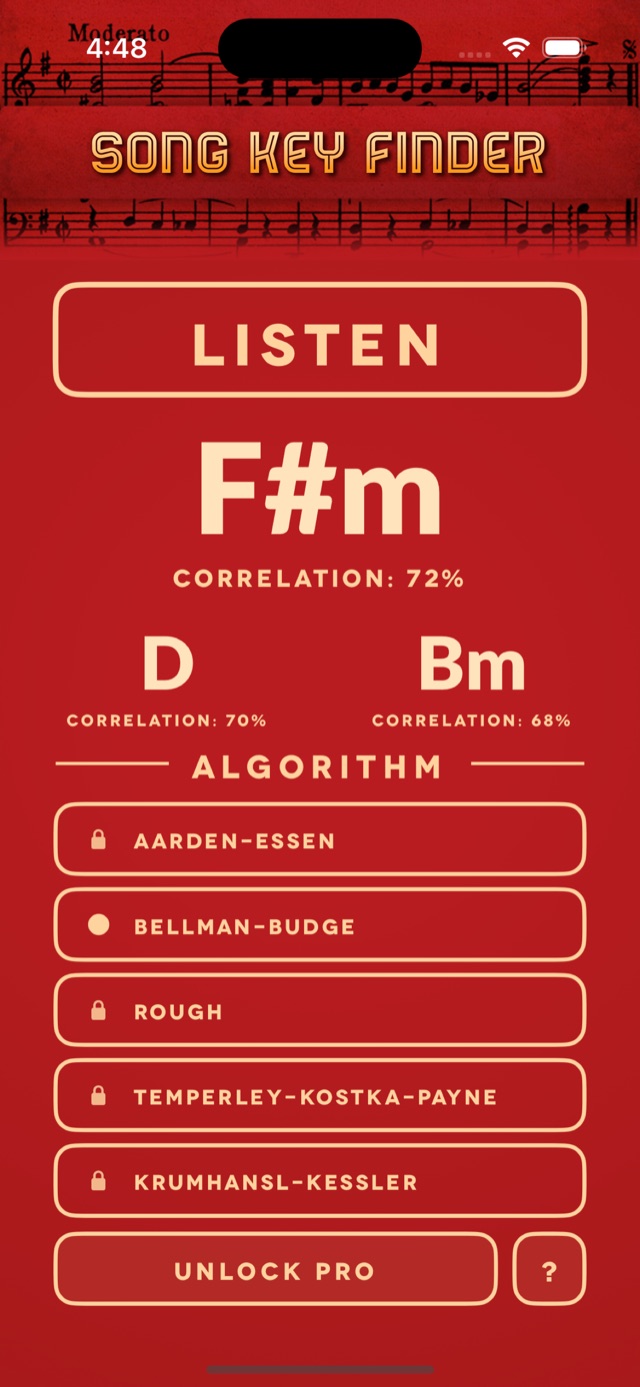
You can work it out by ear: find the note the song comes to rest on, then decide whether it sounds major or minor. Or you can let a phone do the listening. Our app, Trova Song Key Finder, hears a song through the microphone and shows its key, along with two runner-up keys and a score for each, since some songs fit more than one key.


If it is your own voice you are curious about, see what key am I singing in.
Questions and answers
What does “in the key of C” mean?
That the music is built from the notes of the C scale and treats C as its home note, the note where melodies and chord progressions come to rest.
How many keys are there in music?
Twenty-four: twelve major and twelve minor.
Is a key the same as a scale?
Not quite. A scale is a set of notes in order. A key is the wider idea of music organized around a home note, using the scale built on that note and the chords that come from it.
Can a song be in more than one key?
Yes. Many songs change key partway through, and some sit between a major key and its relative minor.
Does the key affect how a song feels?
Major or minor makes a big difference. Which of the twelve notes is home matters much less to the mood, though it changes how high or low the song sits for the singer and the instruments.
Keep reading
- Relative major and minor keys
- Chords in every key: a chart for all 24 keys
- What key am I singing in?
Hear a song, see its key
Trova Song Key Finder is available for iPhone, iPad, and Android. It is a paid app with no subscription and no ads. Learn more about Trova.