A capo is a clamp that presses all six strings down at one fret. Everything you play above it comes out higher, by one semitone for each fret. Your hands keep making the chord shapes they know, and the guitar does the transposing.
The two charts below answer the two questions people ask about capos: what chord am I really playing, and where do I put the capo to play in a particular key?
Capo chord chart: what each shape becomes
Find the shape you are playing on the left, then read across to the fret your capo is on.
| Chord shape | Capo 1 | Capo 2 | Capo 3 | Capo 4 | Capo 5 | Capo 6 | Capo 7 |
|---|---|---|---|---|---|---|---|
| C | Db | D | Eb | E | F | F# | G |
| A | Bb | B | C | Db | D | Eb | E |
| G | Ab | A | Bb | B | C | Db | D |
| E | F | F# | G | Ab | A | Bb | B |
| D | Eb | E | F | F# | G | Ab | A |
| Am | Bbm | Bm | Cm | C#m | Dm | Ebm | Em |
| Em | Fm | F#m | Gm | G#m | Am | Bbm | Bm |
| Dm | Ebm | Em | Fm | F#m | Gm | G#m | Am |
So a G shape with the capo on the second fret sounds as an A chord, and an Am shape with the capo on the third fret sounds as Cm.
Capo key chart: where to put the capo for any key
Find the key you want on the left. Each column shows where the capo goes if you want to play that key using a familiar set of open chord shapes.
| To play in | G shapes | C shapes | D shapes | A shapes | E shapes |
|---|---|---|---|---|---|
| C | Fret 5 | No capo | – | Fret 3 | Fret 8 |
| C# / Db | Fret 6 | Fret 1 | – | Fret 4 | Fret 9 |
| D | Fret 7 | Fret 2 | No capo | Fret 5 | – |
| Eb | Fret 8 | Fret 3 | Fret 1 | Fret 6 | – |
| E | Fret 9 | Fret 4 | Fret 2 | Fret 7 | No capo |
| F | – | Fret 5 | Fret 3 | Fret 8 | Fret 1 |
| F# / Gb | – | Fret 6 | Fret 4 | Fret 9 | Fret 2 |
| G | No capo | Fret 7 | Fret 5 | – | Fret 3 |
| Ab | Fret 1 | Fret 8 | Fret 6 | – | Fret 4 |
| A | Fret 2 | Fret 9 | Fret 7 | No capo | Fret 5 |
| Bb | Fret 3 | – | Fret 8 | Fret 1 | Fret 6 |
| B | Fret 4 | – | Fret 9 | Fret 2 | Fret 7 |
“G shapes” means the chords you would use for a song in G: G, C, D, Em, and Am. A dash means the capo would sit above the ninth fret, where there is too little room to be practical.
Most keys give you a choice. For the key of A you can play G shapes at the second fret, E shapes at the fifth, or D shapes at the seventh. Lower positions sound fuller, and higher ones sound brighter, a little like a mandolin.
Three ways to use the charts
To fit a song to your voice
If a song in G feels too low, put the capo on the second fret and play exactly what you were playing. You are now in A. Too high? A capo can only go up, so switch to a lower set of shapes instead: playing D shapes with a capo on the third fret puts you in F, two semitones below G.
To play in a hard key with easy shapes
Keys such as Eb, Bb, and F# are full of barre chords. The key chart shows the way around them. For Bb, put the capo on the third fret and play G shapes, or on the first fret and play A shapes.
To match a recording
If the chords you looked up sound right but too low, the guitarist on the record probably used a capo. Find the song’s real key first, then use the key chart to see which fret and shapes get you there.
Find the key of the recording
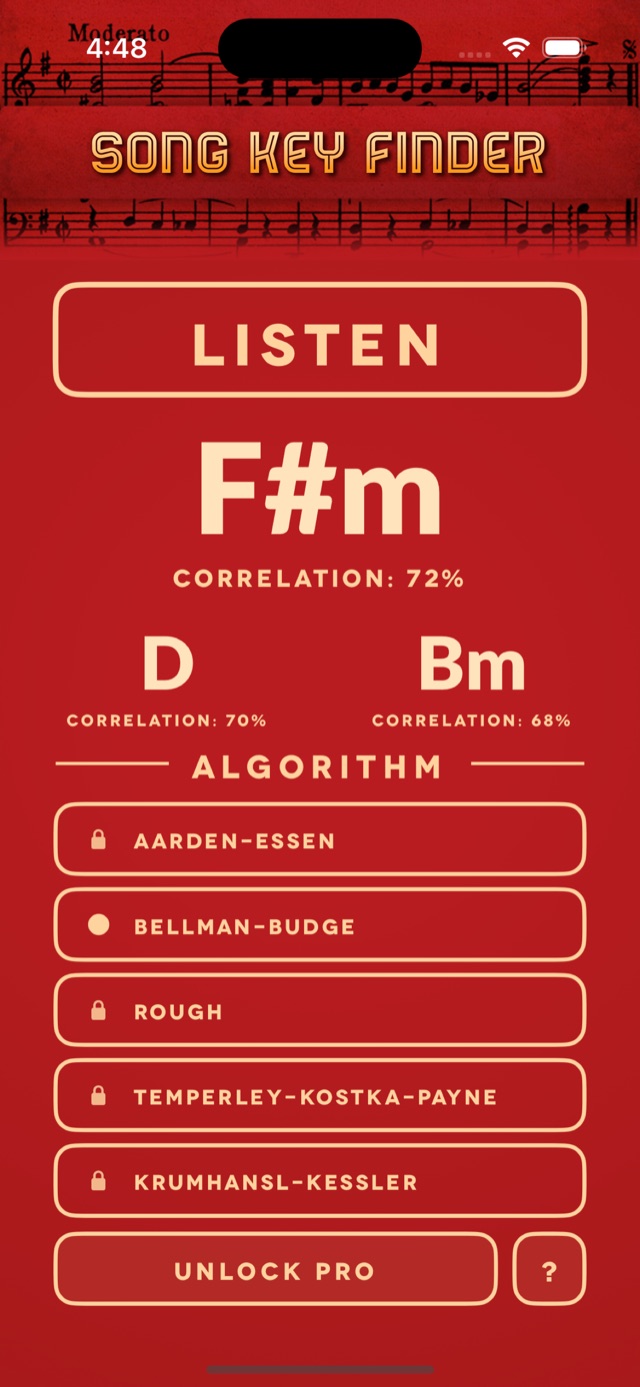
Our app, Trova Song Key Finder, tells you a song’s key by listening to it. Press Listen, play the recording near your phone, and read the key at the top of the screen. Then look up that key in the chart above and pick the capo position with the shapes you like.
It works the other way too. Put the capo on, strum through your chords, and let Trova confirm the key you have ended up in.


Capo tips
- Place it just behind the fret wire, not in the middle of the fret. You will get less buzzing and stay better in tune.
- Check your tuning after you clamp it. A capo can pull the strings slightly sharp.
- Count frets from the capo. With the capo on, treat it as the nut. A chord shape sits the same distance from the capo as it did from the end of the neck.
- Tell the band the real key. If you are playing G shapes at the third fret, the song is in Bb, and that is what the bass player needs to hear.
How the math works
Each fret is one semitone, and there are twelve semitones before the note names repeat: C, C#, D, Eb, E, F, F#, G, Ab, A, Bb, B. A capo on the fourth fret moves every chord four names along that list. C becomes E, G becomes B, and Am becomes C#m. To move a song by more than a capo allows, or downward, see our guide to transposing a song.
Questions and answers
Does a capo change the key?
Yes. Each fret raises the pitch of everything you play by one semitone, so the key rises with it.
What key is capo 2 with G chords?
A major. G shapes with the capo on the second fret sound two semitones higher.
What key is capo 3 with C chords?
Eb major. C shapes with the capo on the third fret sound three semitones higher.
Where do I put the capo for the key of Bb?
On the third fret with G shapes, or on the first fret with A shapes.
What does capo 4 with an Em shape sound as?
G#m, which is also written Abm.
Is using a capo cheating?
No. It is a standard tool, used by professional players to get open-string sounds in keys where they would not otherwise be available.
Keep reading
- How to transpose a song into your key
- Chords in every key: a chart for all 24 keys
- How to learn a song by ear: start with the key
Find the key, then place the capo
Trova Song Key Finder is available for iPhone, iPad, and Android. It is a paid app with no subscription and no ads. Learn more about Trova.