Play the white keys of a piano from C to C and you get the C major scale. Play the same white keys from A to A and you get A minor. The notes are identical. Only the starting point has changed, and with it the whole mood.
C major and A minor are relative keys. Every major key has one relative minor, and every minor key has one relative major. This page has the full chart, two quick ways to find a relative key, and a way to tell which of the pair a song is really in.
Chart of relative major and minor keys
| Major key | Relative minor | Key signature | Sharps or flats |
|---|---|---|---|
| C major | A minor | None | – |
| G major | E minor | 1 sharp | F# |
| D major | B minor | 2 sharps | F#, C# |
| A major | F# minor | 3 sharps | F#, C#, G# |
| E major | C# minor | 4 sharps | F#, C#, G#, D# |
| B major | G# minor | 5 sharps | F#, C#, G#, D#, A# |
| F# major | D# minor | 6 sharps | F#, C#, G#, D#, A#, E# |
| Db major | Bb minor | 5 flats | Bb, Eb, Ab, Db, Gb |
| Ab major | F minor | 4 flats | Bb, Eb, Ab, Db |
| Eb major | C minor | 3 flats | Bb, Eb, Ab |
| Bb major | G minor | 2 flats | Bb, Eb |
| F major | D minor | 1 flat | Bb |
F# major can also be written as Gb major, with six flats. Its relative minor, D# minor, is then written as Eb minor.
How to find a relative key
From major to minor: go down three semitones
Start on the major key’s home note and count down three semitones, which is three frets on a guitar or three keys on a piano, black keys included. From C: B, Bb, A. The relative minor of C major is A minor.
You can also count up the scale. The relative minor starts on the sixth note of the major scale. In G major the notes are G, A, B, C, D, E, and F#, so the sixth is E, and the relative minor is E minor.
From minor to major: go up three semitones
From A: Bb, B, C. The relative major of A minor is C major. It is also the third note of the minor scale.
Same notes, different home
If the notes are the same, what is different? The note that feels like home.
In C major, melodies and chord progressions keep pulling toward C, and a phrase that ends there sounds finished. In A minor the same notes are arranged around A. End a phrase on A and it sounds finished in a darker way. The seven chords are the same too, as our chart of the chords in every key shows. In C major the C chord is home. In A minor the Am chord is.
How to tell which one a song is in
- Listen to where it comes to rest. The last chord of the song, or of the chorus, is usually the home chord. If a song with no sharps or flats ends on Am, it is in A minor.
- Look for the telltale chord. Minor-key songs very often turn their fifth chord into a major chord. In A minor that is E major, which contains a G#, a note that is not in the key of C at all. If you see E or E7 leading to Am, the song is in A minor.
- Listen to the bass. The bass tends to sit on the home note at the important moments: the first bar, the start of the chorus, the ending.
- Don’t rely on mood alone. Plenty of major-key songs are sad and plenty of minor-key songs are danceable.
Some songs won’t settle the question. A verse can sit in the minor and the chorus in the relative major, and both answers are fair.
Why a key finder shows you both
Software works out a key by measuring which notes it hears most. A major key and its relative minor contain exactly the same notes, so the evidence for each is nearly the same. The difference lies in which notes are emphasized, and that can be a close call.
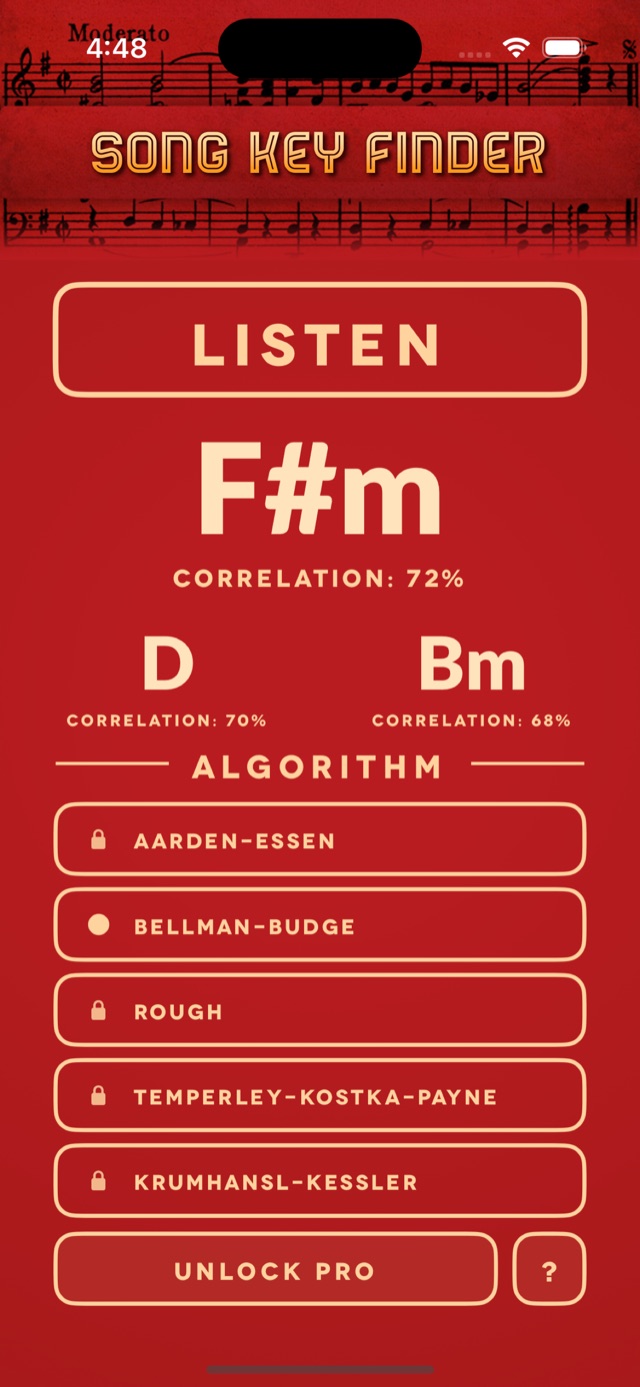
That is why our app, Trova Song Key Finder, doesn’t give a single answer. It shows the most likely key and two runners-up, each with a score. When you see a major key and its relative minor at the top with similar scores, you know what is going on, and you can use the tests above to choose.


Relative is not the same as parallel
Two terms get mixed up:
- Relative keys share the same notes and have different home notes. C major and A minor.
- Parallel keys share the same home note and have different notes. C major and C minor.
C minor has three flats, so it differs from C major by three notes. Moving between parallel keys is a much bigger change in sound than moving between relatives.
What relative keys are good for
- Songwriting. Moving from a minor verse to its relative major for the chorus is one of the oldest ways to make a chorus lift, and it needs no new notes.
- Improvising. One scale covers both keys. If you can solo in A minor, you can already solo in C major.
- DJ mixing. Tracks in relative keys blend cleanly. On the Camelot wheel, relatives share a number: 8A is A minor and 8B is C major.
- Reading music. Relative keys share a key signature, so the sharps or flats at the start of the staff narrow a piece down to two possible keys.
Questions and answers
What is the relative minor of C major?
A minor. Both keys use only the white keys of the piano.
What is the relative minor of G major?
E minor. Both keys have one sharp, F#.
What is the relative major of A minor?
C major. Count up three semitones from A to find it.
How do you find the relative minor of any major key?
Go down three semitones from the major key’s home note, or take the sixth note of its scale.
Do relative major and minor keys have the same chords?
Yes. They share the same seven notes and so the same seven basic chords. The difference is which chord feels like home.
What is the difference between relative and parallel minor?
The relative minor shares its notes with the major key and starts on a different note. The parallel minor starts on the same note and uses different notes.
Keep reading
- What is a key in music?
- Chords in every key: a chart for all 24 keys
- Camelot wheel chart: all 24 keys
See which keys a song could be in
Trova Song Key Finder is available for iPhone, iPad, and Android. It is a paid app with no subscription and no ads. Learn more about Trova.