Your vocal range is the distance between the lowest note and the highest note you can sing. This test finds both in about two minutes. It runs in your browser and doesn’t use your microphone: the page plays a note, you sing it back, and you decide whether you got there.
Take the test
Use headphones or turn your volume up, and hum for a minute first to warm up. Sing each note on a relaxed “ah,” at a comfortable volume. Nothing should hurt. If it does, stop there.
1. Find your lowest note
Press Play and sing the note you hear. If you can’t sing it at all, press Higher until you can. Then step lower, one note at a time, until your voice turns breathy or the note won’t sound. Go back up to the last note that came out clearly.
C3
2. Find your highest note
Now step higher, one note at a time, until your voice cracks or you have to strain. Go back down to the last note that came out clearly. Notes you can only reach in a light, airy voice still count, so use them.
C4
3. See your range
No sound? On a phone, switch off silent mode and turn the media volume up.
You can do the same test with a piano, a keyboard, or any piano app. Start near the middle, play one note at a time, and sing each one back as you work down to your lowest note and then up to your highest. Middle C is C4.
How to read your result
Notes are written as a letter and a number. The letter is the note name, and the number is the octave it sits in. Middle C on a piano is C4. The C above it is C5, and the C below it is C3.
Your range is written from the lowest note to the highest, such as G2 to E4. You can also count it. Twelve semitones make an octave, so a range of 19 semitones is one octave and seven semitones. Most people who haven’t trained their voice have somewhere between one and a half and two octaves.
Voice types and their typical ranges
Choirs and singing teachers group voices into types. These are the ranges usually given for each.
| Voice type | Typical range |
|---|---|
| Soprano | C4 to C6 |
| Mezzo-soprano | A3 to A5 |
| Alto (contralto) | F3 to F5 |
| Tenor | C3 to C5 |
| Baritone | A2 to A4 |
| Bass | E2 to E4 |
Treat the label as a rough guide. Sources differ by a note or two, especially for baritones, and many people fall between two types. A singing teacher will also consider where your voice sounds best and where it changes quality, not only the two extreme notes. A baritone with a few high notes is still a baritone.
What your range is for: choosing keys
The practical use of knowing your range is picking the right key for a song. A typical melody covers about an octave to an octave and a half. Your range is probably wider than that, which means almost any song will fit your voice in some key. It just may not be the key on the recording.
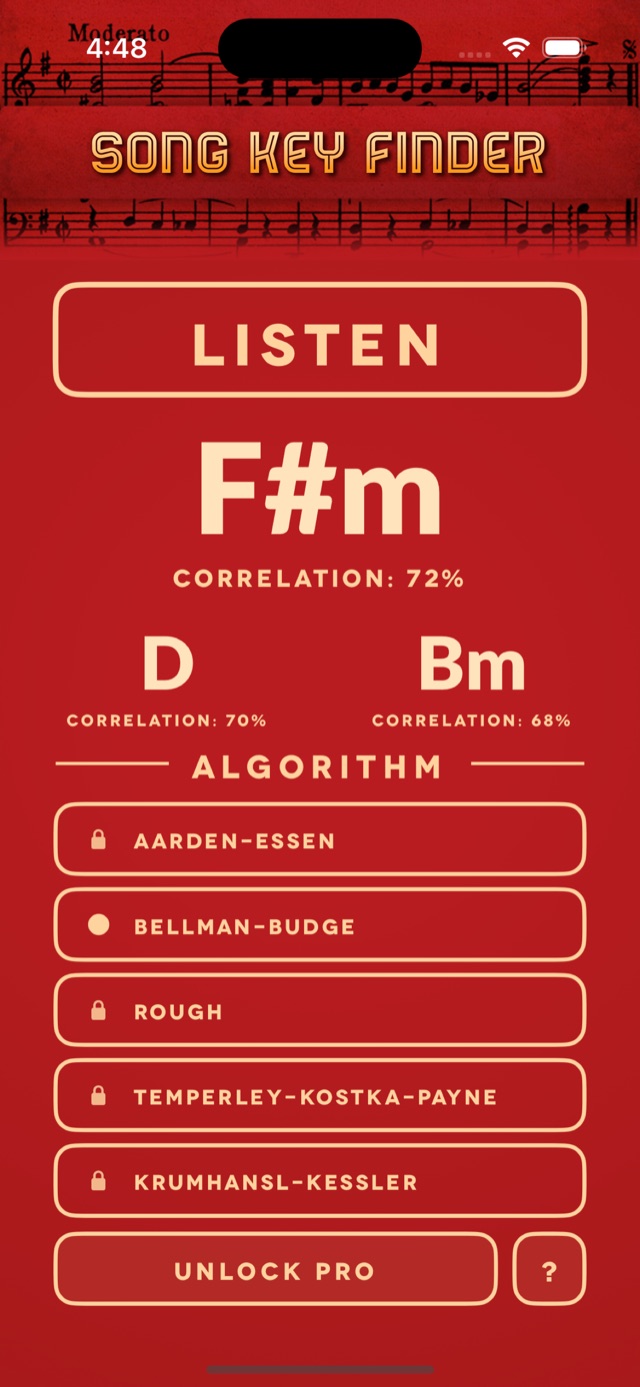
- Find the key the song is in. Our app, Trova Song Key Finder, listens to a recording through your phone’s microphone and shows its key. You can also sing into it to see what key you are singing in.
- Find the song’s highest and lowest notes and compare them with your own.
- Move the song up or down until both ends fit. Our guide to transposing a song shows how, and guitarists can use a capo.


Getting a truer result
- Test more than once. Voices are lower in the morning and after a cold, and higher once they are warm.
- Note two top notes if you like: the highest you can sing in your full voice, and the highest you can reach in a light head voice or falsetto. Both are part of your range.
- Comfortable beats possible. The notes you can sing easily and repeatedly matter more for choosing songs than the one note you can touch on a good day.
- Range grows with practice. Regular singing and good technique usually add notes at both ends over time.
Questions and answers
How do I find my vocal range?
Find the lowest note you can sing clearly and the highest note you can sing without straining, and name them using a piano or the test on this page. The span between them is your range.
What is the average vocal range?
Most untrained singers have between one and a half and two octaves. Trained singers often have more.
What is my voice type?
Compare your range with the typical ranges for soprano, mezzo-soprano, alto, tenor, baritone, and bass. The closest match is a reasonable first guess, though voice type also depends on where your voice sounds strongest.
Does this test use my microphone?
No. The page plays notes and you judge for yourself whether you matched them. Nothing is recorded.
What note is middle C?
C4. It is the C nearest the middle of a piano keyboard.
Can I increase my vocal range?
Usually, yes. Regular practice and good technique tend to extend a voice at both ends. A singing teacher can help you do it safely.
Keep reading
Next, find the key of the song
Trova Song Key Finder is available for iPhone, iPad, and Android. It is a paid app with no subscription and no ads. It finds the key of a song, not your vocal range. Learn more about Trova.