Transposing means moving a whole song to a different key. Every note and every chord shifts by the same distance, so the song sounds the same, only higher or lower. Singers do it to fit their range, guitarists do it to get friendlier chords, and bands do it so that everyone can play together.
It takes four steps and one chart.
Step 1: find the key the song is in now
If you have sheet music or a chord chart, the key is often printed at the top. If you are working from a recording, the fastest way is to let an app listen to it. Our app, Trova Song Key Finder, hears the song through your phone’s microphone and shows the key, along with two runner-up keys in case it is a close call.
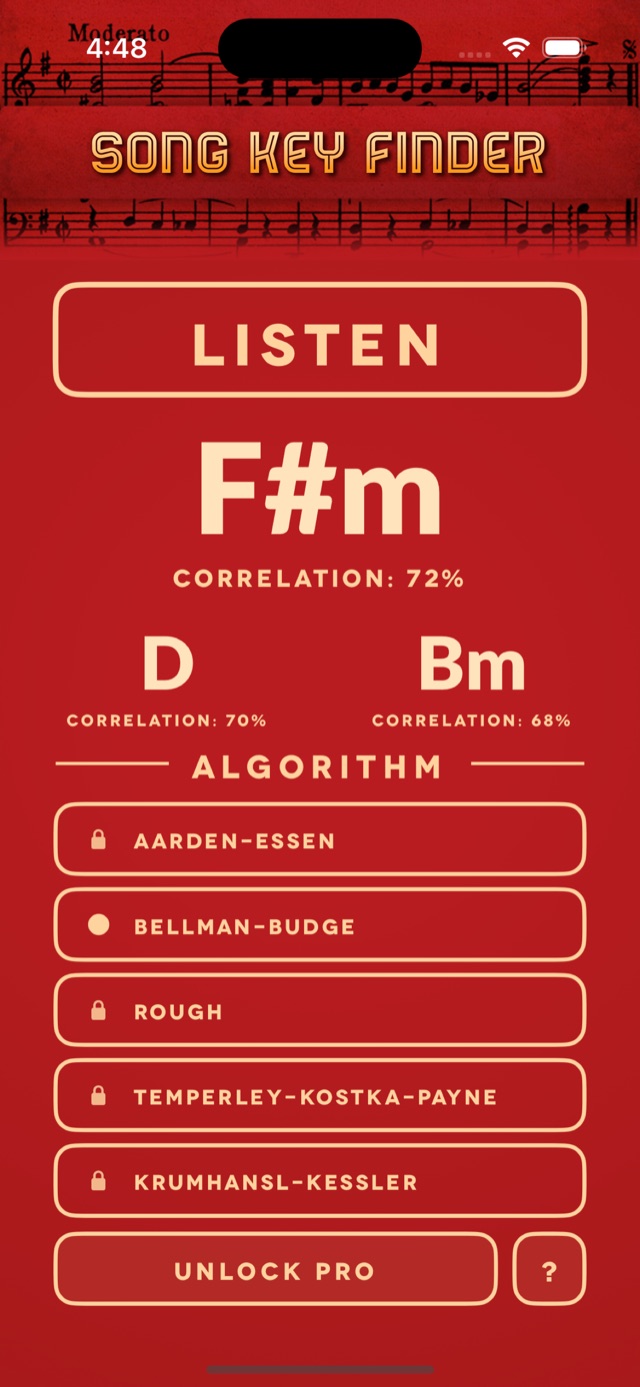


You can also work it out from the chords. Look up the chords you know in our chart of the chords in every key and find the row that contains all of them.
Step 2: choose the new key
What you choose depends on why you are transposing.
- For your voice: find the highest note of the melody. If it strains, count how many semitones lower it would need to be to feel comfortable. If the low notes vanish, count upward instead. Moving a song by two to five semitones is common when it was written for a different voice. Our vocal range test will tell you where your limits are.
- For easier chords: on guitar, the keys of G, C, D, A, and E use mostly open chords. On piano, C, G, and F have the fewest black keys.
- For another instrument: see the section on transposing instruments below.
Step 3: count the distance
Count the semitones from the old key to the new one. A semitone is one fret on a guitar or one key on a piano, counting black keys too. From G up to A is two semitones. From G down to E is three.
Step 4: move every chord the same distance
Shift the letter name of each chord by that number of semitones. Leave everything after the letter alone. A minor chord stays minor, and a seventh chord stays a seventh.
The chart below does the counting for you. Each row is a key, starting on its home note. The numbered columns are the notes of that key’s major scale, and the columns without a number are the notes in between.
| 1 | 2 | 3 | 4 | 5 | 6 | 7 | |||||
|---|---|---|---|---|---|---|---|---|---|---|---|
| C | C# | D | D# | E | F | F# | G | G# | A | A# | B |
| Db | D | Eb | E | F | Gb | G | Ab | A | Bb | B | C |
| D | D# | E | F | F# | G | G# | A | A# | B | C | C# |
| Eb | E | F | Gb | G | Ab | A | Bb | B | C | Db | D |
| E | F | F# | G | G# | A | A# | B | C | C# | D | D# |
| F | Gb | G | Ab | A | Bb | B | C | Db | D | Eb | E |
| F# | G | G# | A | A# | B | C | C# | D | D# | E | F |
| G | G# | A | A# | B | C | C# | D | D# | E | F | F# |
| Ab | A | Bb | B | C | Db | D | Eb | E | F | Gb | G |
| A | A# | B | C | C# | D | D# | E | F | F# | G | G# |
| Bb | B | C | Db | D | Eb | E | F | Gb | G | Ab | A |
| B | C | C# | D | D# | E | F | F# | G | G# | A | A# |
To use it:
- Find the row that starts with the key the song is in now.
- Find each of the song’s chord letters in that row and note which column it is in.
- Read the letter in the same column of the row that starts with the new key.
- Put back whatever followed the letter: m, 7, maj7, sus4, and so on.
Some rows spell the in-between notes as sharps and others as flats. They are the same notes: A# is Bb, C# is Db, D# is Eb, F# is Gb, and G# is Ab.
A worked example
A song in G uses the chords G, D, Em, and C. It sits too low, so you decide to raise it two semitones, to the key of A.
| Chord 1 | Chord 2 | Chord 3 | Chord 4 | |
|---|---|---|---|---|
| Original, in G | G | D | Em | C |
| Transposed, in A | A | E | F#m | D |
In the row that starts with G, the letters G, D, E, and C sit under 1, 5, 6, and 4. Under the same numbers in the row that starts with A are A, E, F#, and D. The minor chord stays minor, so Em becomes F#m.
Shortcuts
- Guitar: a capo transposes upward without changing your chord shapes. Capo on the second fret and the G shapes above come out in A. Our capo chart covers every fret.
- Digital pianos and keyboards: most have a transpose button that shifts the whole instrument by semitones, so you can keep playing the fingering you know.
- Number charts: if you write a song as numbers (1, 4, 5, 6m) instead of letters, it is ready to play in any key. The numbers across the top of the chart are the ones to use.
Transposing instruments
Some wind instruments are built so that the note written on the page is not the note that sounds. To play along with a piano or guitar, their parts have to be written in a different key:
- B-flat instruments (trumpet, clarinet, soprano and tenor saxophone): write the part two semitones higher than the piano’s key. A song in C is written in D.
- E-flat instruments (alto and baritone saxophone): write it three semitones lower, or nine higher. A song in C is written in A.
- Horn in F: write it seven semitones higher. A song in C is written in G.
Check your work
Play the first and last chords of the new version. They should feel like the same resting place as before, only higher or lower. If one chord sounds wrong, you probably shifted it by a different amount from the others. If you want a second opinion, play your new version and let Trova listen: it should now report the key you were aiming for.
Questions and answers
What does it mean to transpose a song?
To move it to a different key by shifting every note and chord the same distance up or down. The tune stays the same and the pitch changes.
How do I transpose chords to a different key?
Count the semitones between the old key and the new one, then move each chord’s letter name by that amount. Keep the chord type the same, so minor stays minor.
Does transposing change major chords to minor?
No. Only the letter names change. Every chord keeps its type.
What is the easiest way to transpose on guitar?
Use a capo. Each fret raises the key by one semitone while you keep playing the same shapes.
How do I know which key suits my voice?
Find the highest and lowest notes of the melody and compare them with the top and bottom of your comfortable range. Shift the song until both ends fit.
Keep reading
- Capo chart: your chords and key on every fret
- Chords in every key: a chart for all 24 keys
- What key am I singing in?
Start with the right key
Trova Song Key Finder is available for iPhone, iPad, and Android. It is a paid app with no subscription and no ads. Learn more about Trova.