The Camelot wheel is a chart that gives each of the 24 musical keys a short code: a number from 1 to 12 and the letter A or B. DJs use it for harmonic mixing, because the codes show at a glance which tracks will blend and which will clash. You don’t need to read music to use it.
Below are the wheel, a table for looking up any key, and the three moves that keep a mix in key.
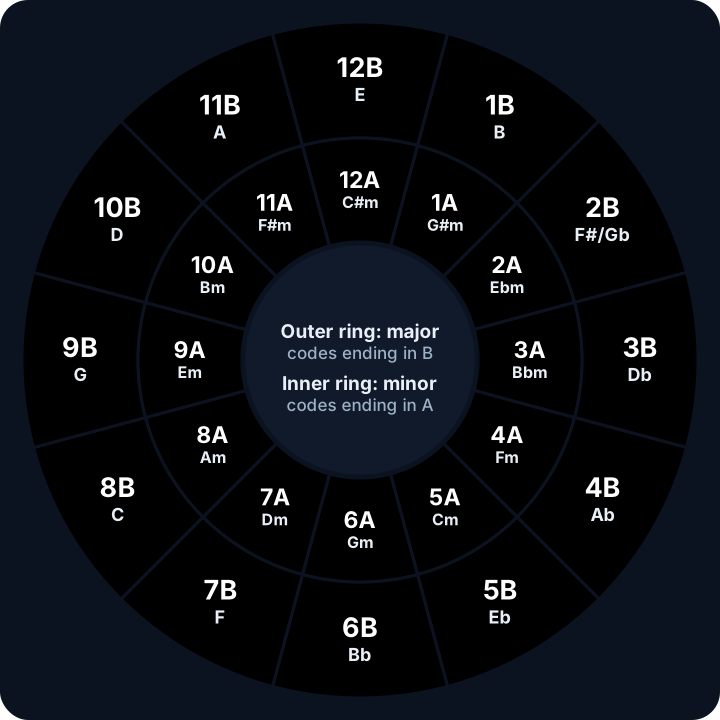
Camelot codes for all 24 keys
Look up a key to find its code.
| Major key | Code | Minor key | Code |
|---|---|---|---|
| C major | 8B | C minor | 5A |
| D-flat major | 3B | C-sharp minor | 12A |
| D major | 10B | D minor | 7A |
| E-flat major | 5B | E-flat minor | 2A |
| E major | 12B | E minor | 9A |
| F major | 7B | F minor | 4A |
| F-sharp major | 2B | F-sharp minor | 11A |
| G major | 9B | G minor | 6A |
| A-flat major | 4B | G-sharp minor | 1A |
| A major | 11B | A minor | 8A |
| B-flat major | 6B | B-flat minor | 3A |
| B major | 1B | B minor | 10A |
Some keys have two names. F-sharp major is the same as G-flat major, and D-flat minor is the same as C-sharp minor. The code is the same whichever name your software uses.
The wheel in order
This is the same information arranged by number, with the Open Key codes used by some DJ software.
| Number | Minor code | Minor key | Major code | Major key | Open Key |
|---|---|---|---|---|---|
| 1 | 1A | G-sharp minor (Abm) | 1B | B major (Cb) | 6m / 6d |
| 2 | 2A | E-flat minor (D#m) | 2B | F-sharp major (Gb) | 7m / 7d |
| 3 | 3A | B-flat minor (A#m) | 3B | D-flat major (C#) | 8m / 8d |
| 4 | 4A | F minor | 4B | A-flat major | 9m / 9d |
| 5 | 5A | C minor | 5B | E-flat major | 10m / 10d |
| 6 | 6A | G minor | 6B | B-flat major | 11m / 11d |
| 7 | 7A | D minor | 7B | F major | 12m / 12d |
| 8 | 8A | A minor | 8B | C major | 1m / 1d |
| 9 | 9A | E minor | 9B | G major | 2m / 2d |
| 10 | 10A | B minor | 10B | D major | 3m / 3d |
| 11 | 11A | F-sharp minor | 11B | A major | 4m / 4d |
| 12 | 12A | C-sharp minor (Dbm) | 12B | E major | 5m / 5d |
How to read it
- The letter tells you major or minor. B is major and sits on the outer ring. A is minor and sits on the inner ring.
- The number is the position around the wheel, laid out like a clock face.
- Neighbors are closely related. Two keys next to each other on the same ring share six of their seven notes.
- A and B at the same number share all seven. 8A is A minor and 8B is C major. They use exactly the same notes.
Three moves that keep a mix in key
Say the track playing is 8A.
- Stay on the same code. Mix into another 8A track. Same key, no clash.
- Move one number, keep the letter. Go to 7A or 9A. The wheel wraps around, so 12 is next to 1.
- Keep the number, switch the letter. Go to 8B. This changes the mood from minor to major, or the other way, without changing the notes.
That gives you four compatible codes for every track: its own and three neighbors. If the next track has one of them, the blend will sound smooth, even with both tracks playing together for a long time.
Riskier moves that can still work
- Up two numbers (8A to 10A) raises the key by a whole step. DJs use it to lift the energy. The two keys share five of seven notes, so keep the overlap short.
- Up seven numbers (8A to 3A) raises the key by a semitone. It is a dramatic jump that works best as a quick cut, not a long blend.
- One number and the letter together (8A to 9B or 7B) also shares six of seven notes. Both the home note and the mood change, though, so it is a bigger shift than it looks on the wheel.
It is the circle of fifths with easier labels
Musicians have used the circle of fifths for centuries to show how keys relate. The Camelot wheel is the same circle with numbers in place of key names. Each step clockwise goes up a fifth, from C to G to D and so on, and each major key sits beside its relative minor. If you already know the circle of fifths, you know the wheel.
Camelot and Open Key
Open Key is a second numbering system that works the same way. It uses d for major and m for minor, and it starts its count at C major, so C major is 1d and A minor is 1m. To convert, Camelot 8 is Open Key 1, Camelot 9 is Open Key 2, and so on around the wheel. The table above lists both.
How to get the code for a track
DJ software analyzes the files in your library and writes the key into each one. That covers everything you own as a file.
For anything else, such as a record playing on a turntable, a track in a streaming app, or a musician you want to play along with, you need something that listens. Our app, Trova Song Key Finder, hears music through your phone’s microphone and shows the key along with two runner-up keys. On iPhone and iPad it can display the result as Camelot codes.
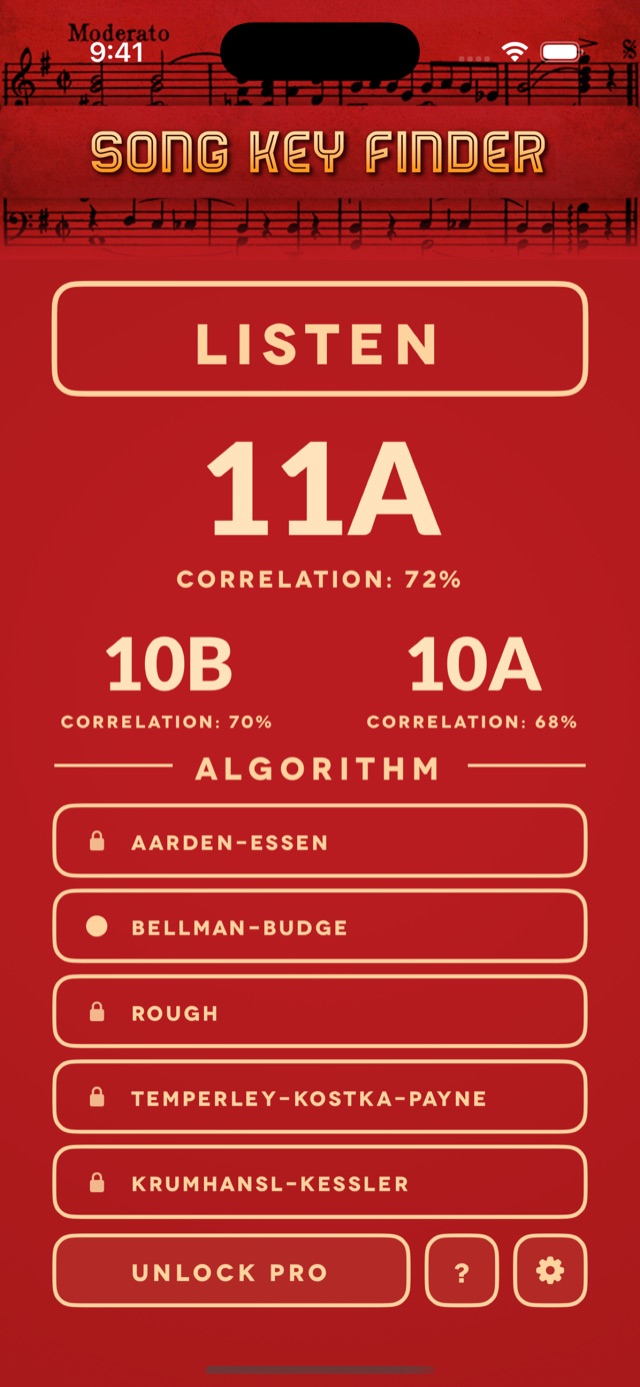


On Android, Trova shows standard key names, and the lookup table at the top of this page turns them into codes.
Where the Camelot system came from
The system is credited to Mark Davis, a DJ who published it in the early 1990s under the name Camelot Sound, as a way to teach harmonic mixing without music theory. It became the standard after 2006, when the DJ software Mixed In Key began analyzing tracks and labeling them with Camelot codes automatically.
Questions and answers
What key is 8A on the Camelot wheel?
A minor. Its major partner, 8B, is C major.
What is the Camelot code for C major?
8B. C major’s relative minor, A minor, is 8A.
Can I mix from an A key to a B key?
Yes, when the number is the same. 5A and 5B share all of their notes, so they mix cleanly. The mood shifts between minor and major.
Is the Camelot wheel the same as the circle of fifths?
Yes. It is the circle of fifths with each key relabeled as a number and a letter, so that you can compare keys without knowing their names.
What do A and B mean on the Camelot wheel?
A means a minor key and B means a major key.
Do I have to mix in key?
No. Plenty of great mixes ignore it, especially with drums-only intros and quick cuts. Mixing in key matters most when two melodic parts overlap for more than a few seconds.
Keep reading
Get the key of anything you can hear
Trova Song Key Finder is available for iPhone, iPad, and Android. It is a paid app with no subscription and no ads, and Camelot notation is currently on iPhone and iPad. Learn more about Trova.
Camelot and Mixed In Key are names used by their respective owners. Polycene is not affiliated with Mixed In Key.