Playing by ear looks like a gift, and it is mostly a method. People who can pick up a song after a few listens are not hearing every note at once. They find the key, then the bass notes, then the chords, and each step narrows down the next.
Here is that method in six steps. It works on guitar, piano, or any instrument that can play chords, and the first three steps work for singers too.
Step 1: listen until you can hum it
Before you touch an instrument, play the song several times and hum along. Hum the melody, then try humming the bass line. If you can’t sing a part back, you don’t know it well enough to find it on an instrument yet.
Step 2: find the key
This is the step that makes everything else easier. A song in a given key draws most of its notes from one scale of seven and most of its chords from one family of seven. Once you know the key, you are choosing between seven options at each step, not twelve notes and dozens of chords.
To find it by ear, hum the note the song comes to rest on, often the last note of the chorus, and match it on your instrument. Then try the major and minor chord on that note to see which fits.
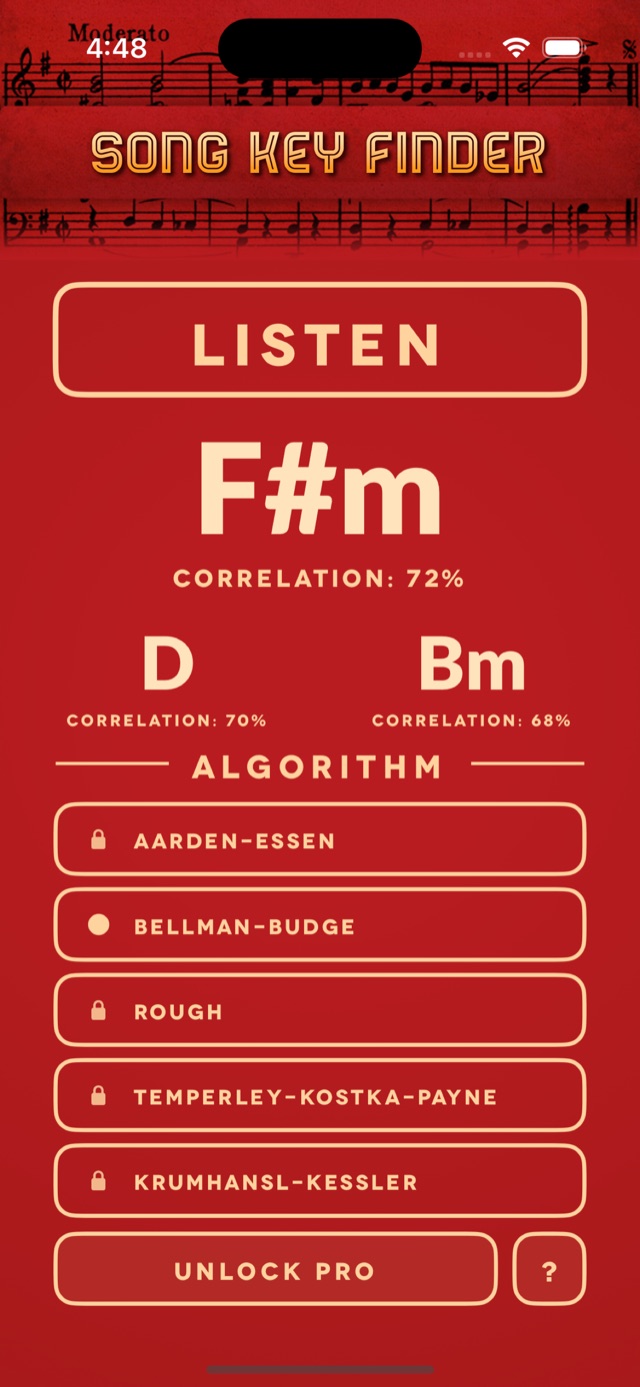
Or let your phone do it. Our app, Trova Song Key Finder, listens to the song through the microphone and shows its key. It also shows two runner-up keys with a score for each, which is useful when a song could be heard as either a major key or its relative minor.


Step 3: find the bass notes
Listen to the lowest instrument. At the moment a chord changes, the bass usually plays the root of the new chord, which is the note the chord is named after. Loop one section and find those bass notes one at a time on your lowest string or with your left hand. They will be notes from the key’s scale.
Write them down in order, with a mark for how long each one lasts. That is the skeleton of the song.
Step 4: turn the bass notes into chords
Each key has a set of seven chords, and each bass note points to one of them. In the key of G they are G, Am, Bm, C, D, Em, and F#dim. If the bass plays G, then E, then C, then D, the chords are very likely G, Em, C, and D. Our chart of the chords in every key has the full list for all 24 keys.
Play your guess along with the recording. A wrong chord is obvious as soon as you hear it against the track. If the chord from the chart sounds off, try swapping major for minor on the same note before you look further.
Step 5: work out the melody
Take the tune a phrase at a time. Sing a phrase, pause the recording, and find the notes. They will nearly all come from the key’s scale, and the important ones tend to be notes of whichever chord is playing underneath. The first and last notes of a phrase are the easiest to find, so get those and fill in between.
Step 6: check, slow down, and loop
Play the whole thing along with the recording. Where it sounds wrong, isolate that bar. Most music players and video sites can slow playback without changing the pitch, and many can loop a section. Fast passages that seemed impossible at full speed are usually simple at three-quarter speed.
Shortcuts that work
- Try the big four first. A large share of popular songs use only the I, IV, V, and vi chords of their key. In G that is G, C, D, and Em.
- Listen for the changes, not the chords. Tap the beat and notice when the harmony moves. Changes usually land on the first beat of a bar.
- Use the ending. The last chord of a song is nearly always the home chord. It confirms the key.
- Use a capo for awkward keys. If the song turns out to be in Eb, a capo lets you play it with easy shapes. See our capo chart.
When it won’t come out right
- Everything sounds slightly off. Some recordings are not tuned to standard pitch, and many rock bands tune their guitars down a semitone. If your chords sound right but a touch too high, try the key one semitone lower.
- The key seems to switch. A song that could be in C major or A minor uses the same notes either way. Our guide to relative major and minor explains how to tell them apart, and why it often doesn’t matter.
- One chord doesn’t fit the key. Songs borrow chords from outside the key all the time. Find the bass note, then try major, minor, and seventh chords on it.
- The song changes key. If the last chorus suddenly sounds higher, it probably moved up a semitone or two. Find the key again from that point.
How to practice
Start with songs that have three or four chords and a clear bass line: folk songs, early rock and roll, most country, a lot of pop. Do one a week. The first will take an evening. By the tenth, you will be finding the key and the main chords in a few minutes, and you will start recognizing common progressions before you have even picked up the instrument.
Questions and answers
Can anyone learn to play by ear?
Yes. It is a skill built by practice, not a talent you either have or don’t. Finding the key first and then the bass notes gives beginners a reliable way in.
Do I need perfect pitch to play by ear?
No. Perfect pitch is the ability to name a note with no reference. Playing by ear uses relative pitch, which is hearing how notes relate to each other, and almost everyone can develop that.
What is the first step in learning a song by ear?
Listen until you can hum it, then find the key. The key tells you which notes and chords the song is most likely to use.
How do I figure out the chords of a song by ear?
Find the key, pick out the bass note at each chord change, and match each bass note to the chord built on it in that key. Then check your chords against the recording.
Does Trova Song Key Finder tell me the chords?
No. It reports the key only. The key narrows the chords down to a family of seven, and the bass line tells you which one is playing.
Keep reading
- Chords in every key: a chart for all 24 keys
- What is a key in music?
- Capo chart: your chords and key on every fret
Start with the key
Trova Song Key Finder is available for iPhone, iPad, and Android. It is a paid app with no subscription and no ads. Learn more about Trova.