The rhombic triacontahedron is a solid with 30 identical diamond-shaped faces. If you have ever rolled a 30-sided die, you have held one. It is also the board in our game Triaconta, which takes its name from the Greek word for thirty.
This is a short tour of the shape: its numbers, where it comes from, where it turns up, and why it works as a game board.
The shape in numbers
- 30 faces, all the same size and shape. Each one is a rhombus, a four-sided diamond with equal sides.
- 60 edges, all the same length.
- 32 corners of two kinds: 12 where five faces meet and 20 where three faces meet.
- 144 degrees between any two neighboring faces.
- 4 neighbors for every face, one across each edge.
Thirty golden diamonds
Each face is a golden rhombus. Its long diagonal divided by its short diagonal is the golden ratio, about 1.618. That fixes the angles: the two sharp corners measure about 63.4 degrees and the two wide ones about 116.6 degrees.
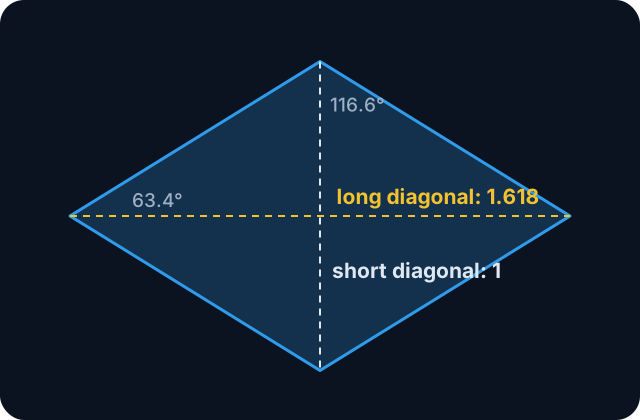
The sharp corners meet in fives and the wide corners meet in threes, which is where the two kinds of corner come from.
Where the shape comes from
There are two easy ways to picture it.
The first uses two better-known solids. An icosahedron has 12 corners and a dodecahedron has 20. Put them together at the right sizes and those 32 points are exactly the corners of a rhombic triacontahedron. The long diagonal of each face is an edge of the icosahedron, and the short diagonal is an edge of the dodecahedron.
The second is as a dual. The rhombic triacontahedron is the dual of a solid called the icosidodecahedron, which has 32 faces and 30 corners. Swap faces for corners and you get 30 faces and 32 corners.
That makes it one of the thirteen Catalan solids, the duals of the Archimedean solids. They are named after Eugène Catalan, who completed the list in 1865. The shape itself is older: Johannes Kepler is generally credited with describing it first, in the early 1600s.
Six rings of ten
This is the property that matters most for a board game. Pick any face and walk straight across it, out through the opposite edge, and keep going. You cross ten faces and arrive back where you started. That loop is a ring.
The solid has exactly six of these rings, and they fit together neatly:
- Every face lies on exactly two rings, one for each pair of opposite edges.
- Any two rings cross at exactly two faces, on opposite sides of the solid.
- The two rings through a face cover 18 of the 30 faces between them.

Mathematicians call a solid like this a zonohedron, and the rings are its zones.
Where you have seen it
- Thirty-sided dice. The d30 used in some tabletop games is a rhombic triacontahedron. Because every face is identical, it makes a fair die.
- Puzzles and toys. Roger von Oech’s Ball of Whacks is a set of 30 magnetic pieces that assemble into this shape.
- Lamps. The Danish designer Holger Strøm based his IQ-light, a lampshade built from interlocking pieces, on it.
Why it makes a good game board
A flat Reversi board has three kinds of squares: corners, edges, and the middle. Corners can never be captured, and most of the strategy grows out of that. On a rhombic triacontahedron every face is the same. Each has four neighbors, each sits on two rings, and none is a corner.
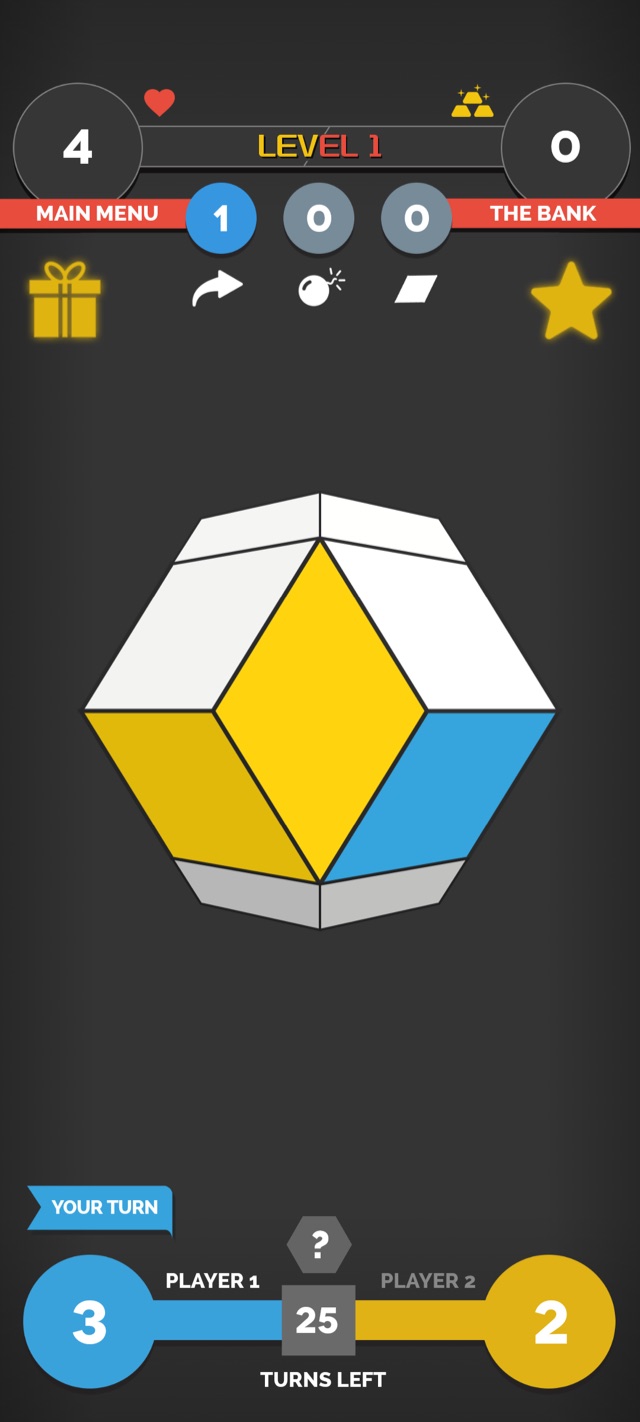
Triaconta uses the faces as tiles and the rings as lines. You capture by trapping your opponent’s tiles along a ring between two of your own, and because a ring has no end, a capture can come from the far side of the board. Thirty tiles also make for quick rounds.


For what that does to the strategy, see our Reversi strategy guide, which includes simulations on this board.
Questions and answers
How many faces does a rhombic triacontahedron have?
Thirty. It also has 60 edges and 32 corners.
What does triacontahedron mean?
It comes from the Greek for thirty faces. Rhombic says that each face is a rhombus.
Is a 30-sided die fair?
The shape is. All 30 faces are identical and sit the same way relative to the center, so a well-made die is equally likely to land on each one.
What is a golden rhombus?
A rhombus whose long diagonal is about 1.618 times its short one. That number is the golden ratio. All 30 faces of the rhombic triacontahedron are golden rhombuses.
Is the rhombic triacontahedron a Platonic solid?
No. Platonic solids have regular polygons for faces. It is a Catalan solid: its faces are identical, but they are rhombuses, and its corners come in two kinds.
Keep reading
- Reversi strategy: how to win, and what changes when the board has no corners
- 3D chess and other 3D board games
- How to play Reversi: the rules in two minutes
Play on the shape
Triaconta is Reversi on a rhombic triacontahedron, free to download for iPhone, iPad, and Android. Learn more about Triaconta.