Reversi takes a minute to learn, and most beginners lose the same way: they flip as many discs as they can on every turn. On a standard board that is usually the wrong plan. The disc count only matters when the game ends, and the discs you grab early are easy to take back.
This guide has two parts. The first covers seven principles that win games of Reversi and Othello on the standard 8×8 board. The second looks at what happens to those principles on a board with no corners and no edges, using simulations we ran on the board from our own game, Triaconta. If you need the rules first, start with how to play Reversi.
Seven principles for the standard board
1. Corners can’t be flipped
A disc is flipped when it sits between two enemy discs in a line. A corner disc has nothing on its far side in any direction, so it can never be flipped. Corners are the only squares that are safe from the moment you take them, and most games turn on who gets them.
2. Stay off the squares next to an empty corner
The three squares touching each corner are the most dangerous on the board. Players call the diagonal one the X-square and the two on the edges C-squares. A disc on any of them, while the corner is still empty, often gives your opponent the line they need to take that corner.
3. Fewer discs early is usually better
It feels wrong, but in the opening and middle game the player with fewer discs is often ahead. Every disc you flip is a disc your opponent can flip back, and a big pile of your color gives them more places to play.
4. Mobility wins the middle game
Mobility is the number of legal moves you have. You must move if you can, so a player who runs out of good moves has to make a bad one, such as an X-square. Aim for positions where you have many safe choices and your opponent has few.
5. Prefer quiet moves
A quiet move flips only a few discs and leaves them surrounded by other discs. Discs that border empty squares are called frontier discs, and each one is a possible move for your opponent. The fewer frontier discs you create, the fewer options you hand over.
6. Build stable discs outward from a corner
Once you own a corner, discs beside it along the edge can become stable too, meaning they can never be flipped for the rest of the game. Stable discs are points in the bank. A corner with a solid edge next to it is worth far more than the corner alone.
7. Count parity at the end
In the last few moves, whoever plays last in each empty region usually comes out ahead, because nobody can answer the final flip. If an empty region has an odd number of squares and it is your move, you can play there and get the last word. Passes change who moves last, so forcing your opponent to pass late in the game is very strong.
What changes when the board has no corners
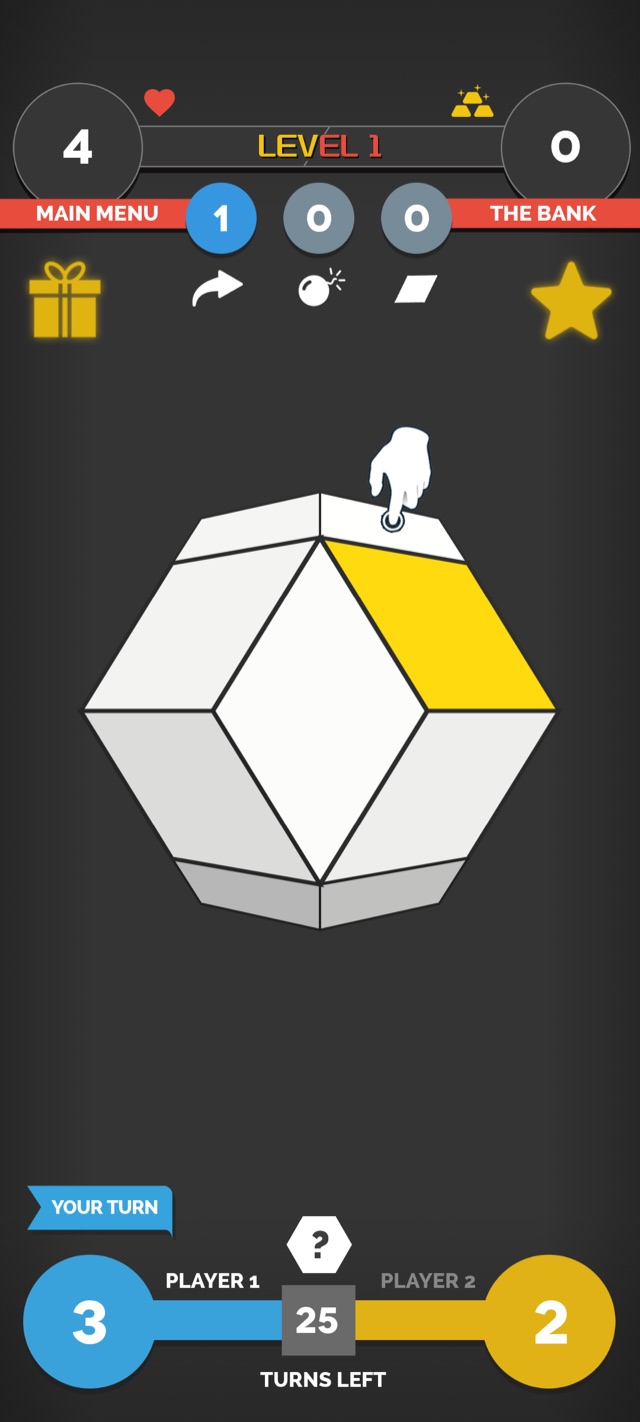
Triaconta uses the same capturing rule on a very different board: 30 diamond-shaped tiles wrapped around a solid. The tiles form six rings of ten, and every tile sits where two rings cross. A line of tiles follows a ring all the way around, so there is no edge for a line to stop at and no corner to hide in.

Principles 1, 2, and 6 are all about corners and edges, so they have nothing to hold on to here. To see what happens to the rest, we ran the board through simulated games.


What we tested
We wrote four very simple computer players and had them play each other, 20,000 games per matchup on Triaconta’s board and 3,000 on a flat 8×8 board. Each follows a single habit. They are crude, and nothing like the game’s Expert opponent, but they show which instincts carry over.
| Matchup | Flat 8×8 board | Triaconta board |
|---|---|---|
| Take the most tiles vs. random moves | 58% to 38% | 63% to 33% |
| Leave the opponent the fewest moves vs. random moves | 67% to 31% | 48% to 48% |
| Leave the opponent the fewest moves vs. take the most tiles | 62% to 36% | 39% to 58% |
| Take the fewest tiles vs. take the most tiles | 30% to 68% | 18% to 81% |
Each cell shows wins for the first player named against wins for the second. The rest were draws.
On the flat board the patient player wins, as the textbooks say: cutting down the opponent’s moves beats grabbing discs. On Triaconta’s board the result flips. The same patient habit did no better than random moves, and lost clearly to the player that simply took the most tiles.
The last move decides most games
In random play, the player who placed the final tile won about nine games in ten. With nothing anchored, the last placement flips a chunk of the board and there is no reply.
Nothing is safe until the end
A tile can only be flipped by a move on one of its two rings, so it becomes permanently safe only when both of those rings are full. In our random games that did not happen until, on average, about three empty tiles were left. In about 97% of games, no tile was safe until five or fewer tiles remained.
Leads don’t last
The lead changed hands about eight times in an average random game, and the player ahead at the halfway point won only 57% of the time. The biggest move of a game flipped nine tiles on average, on a board of 30. In principle one move can flip 16.
Running low on tiles is dangerous
A round ends at once if one color is wiped out, and on a 30-tile board that is a real risk: about 12% of random games ended that way. The “take the fewest tiles” player, which follows principle 3 to the letter, was wiped out again and again.
Looking one move ahead pays
We gave the tile-grabbing player one extra habit: before choosing, subtract the biggest capture the opponent could make in reply. That version beat the plain tile-grabber 68% to 29%.
How to play Triaconta well
- Count the turns left. The game shows how many tiles are still empty. If that number is odd when it is your turn, you will place the last tile as long as nobody passes. If it is even, your opponent will.
- Change the count when it is against you. Leaving your opponent with no legal move makes them pass and hands you the last move. The Skip power-up does the same job, because it gives you two moves in a row.
- Check the reply before you commit. You will usually have only three or four legal moves, so look at each one. Rotate the board and find the biggest capture your opponent would have afterward. Captures often arrive from the far side.
- Don’t starve yourself. Taking as little as possible is a flat-board habit. Here it leaves you one big move away from being wiped out.
- Fill rings late. Once a ring is full, no tile on it can be attacked along that ring again. Near the end, prefer moves that complete a ring running through your own tiles.
- Use the hint button when you are stuck. It shows every legal move, including the ones on the side you can’t see.
Questions and answers
What is the best strategy in Reversi or Othello?
On the standard board: take corners, avoid the squares next to empty corners, keep your disc count low early, leave your opponent with few safe moves, and make sure you get the last move in each region at the end.
Why are corners so important in Reversi?
A corner disc can never be flipped, because no line can pass through it. It also anchors the discs beside it along the edges, which can then become safe too.
Is it better to go first or second in Reversi?
On the standard board it is close. A computer analysis published in 2023 reported that perfect play from both sides ends in a draw. The second player does get the last move if nobody passes, which is a small practical edge.
Does standard Reversi strategy work in Triaconta?
Only partly. Thinking about the last move matters even more, but there are no corners or edges to build from, and playing for a low tile count backfires. In our simulations the patient flat-board approach lost to simply taking more tiles.
Keep reading
- How to play Reversi: the rules in two minutes
- The rhombic triacontahedron: the 30-sided shape behind Triaconta
- Reversi vs. Othello: what’s the difference?
Test it on the thirty-sided board
Triaconta is free to download for iPhone, iPad, and Android, with a 32-round campaign that runs from Novice to Expert. Learn more about Triaconta.
About the simulations: each computer player follows one fixed rule and breaks ties at random. Triaconta games started from the two-player layout, with the players swapping who moved first every game. The figures describe those simple players, not expert play. Othello is a trademark of its respective owner. Triaconta is an independent game and is not affiliated with or endorsed by the makers of Othello.