“3D chess” means two different things. Sometimes it is ordinary chess drawn with three-dimensional graphics: the same 64 squares and the same rules, with nicer pieces. And sometimes it is a different game, where the pieces can also move up and down between levels.
This guide is about the second kind: the best-known three-dimensional chess games, why they are so hard to play, and a few other board games that use a third dimension in more approachable ways.
Raumschach, the classic
The game that chess-variant fans treat as the classic form of 3D chess is Raumschach, German for “space chess.” Ferdinand Maack, a German mathematician, developed it in the early 1900s and patented it in 1907. His argument was that chess is a model of war, and that war now included attacks from above and below.
Maack first tried an 8×8×8 space, found the games long and difficult, and eventually settled on five stacked 5×5 boards. Raumschach adds a new piece, the unicorn, which moves diagonally through the corners of the cells, changing rank, file, and level together. Maack founded a Raumschach club in Hamburg that stayed active until the Second World War.
He was not quite first. The chess master Lionel Kieseritzky is reported to have demonstrated a game called Kubikschach, or cube chess, in the 1850s, but its rules have not survived.
Star Trek Tri-Dimensional Chess
The 3D chess set most people picture is the one from Star Trek, with its three main boards and small movable platforms. It began as a prop. The original was built from store-bought 3D checkers and 3D tic-tac-toe sets, with pieces from a modern-looking chess set, and it was never designed as a playable game.
Fans supplied the rules later. The Star Fleet Technical Manual, published in 1975, gave starting positions and a short description. In 1976 Andrew Bartmess wrote a complete set of Standard Rules, and Jens Meder later published tournament rules that follow standard chess more closely. If you want to play the Star Trek game today, those two rule sets are where to start.
Dragonchess
Gary Gygax, co-creator of Dungeons & Dragons, published Dragonchess in 1985. It uses three stacked 12×8 boards that stand for the sky, the land, and the world underground, and each player commands 42 fantasy-themed pieces. Some can change levels and some can’t, so the three boards feel like connected battlefields.
Why 3D chess is so hard
Adding a dimension multiplies everything. A king in the middle of a flat board touches 8 squares. In a three-dimensional array it can touch 26 cells, which makes it much harder to trap. Maack himself noted that checkmate is significantly harder in space than on a board.
The other problem is seeing. On a flat board you take in every line at a glance. With stacked boards you have to imagine lines passing through levels, and most people find that tiring. It is why the largest formats have always attracted more inventors than players.
Other board games in three dimensions
3D tic-tac-toe
The easiest 3D game to try is tic-tac-toe on a 4×4×4 cube, sold for years under the name Qubic. You win with four in a row in any direction, including diagonals that pass through all four levels. It can be played on paper with four 4×4 grids side by side. It has also been solved: with perfect play the first player wins, a result published in 1980 after about 1,500 hours of computer time.
Score Four
Score Four, first sold in 1968, is four-in-a-row with gravity. Players drop beads onto a 4×4 grid of upright rods, building upward, and try to line up four in any direction. It came out several years before Connect Four.
Reversi on a solid
There is another way to use three dimensions: keep the board a surface, and wrap it around a solid. Our game Triaconta does this with Reversi. Its 30 tiles cover a 30-sided shape, and a line of tiles runs all the way around it instead of stopping at an edge.
The advantage over stacked boards is that you can see it. You rotate the solid with a finger, and every line you need to check is a ring around it.
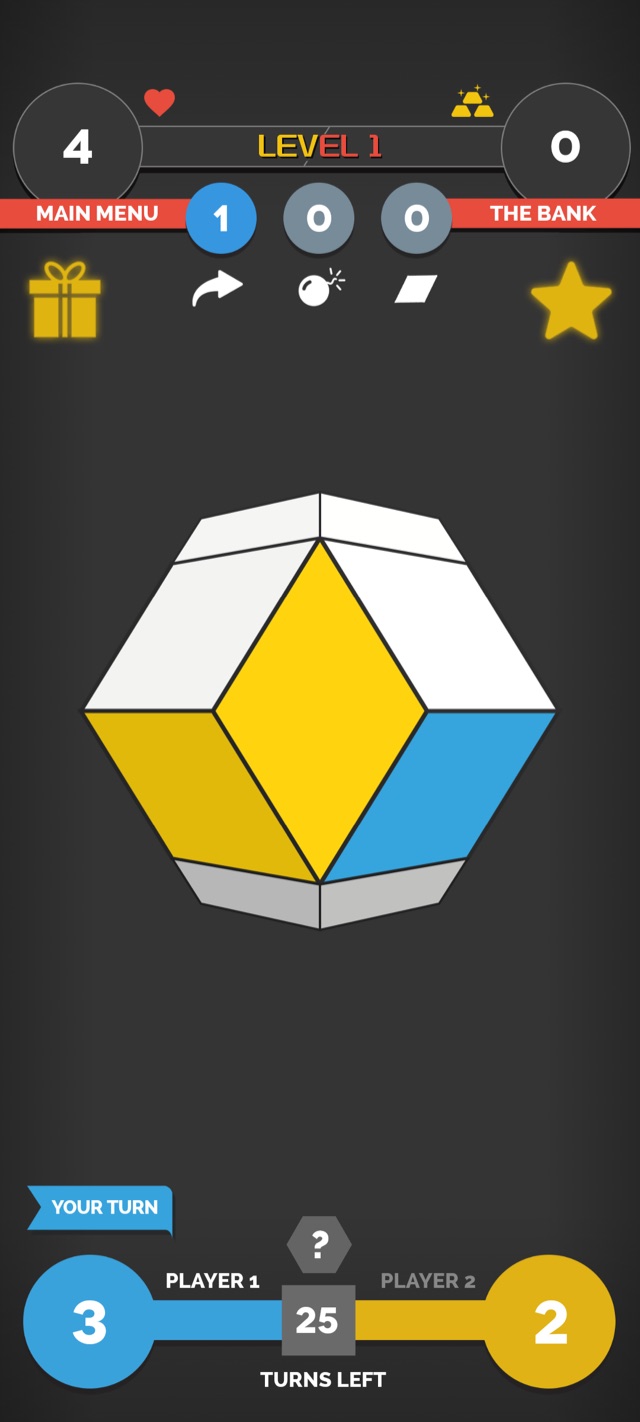


The shape has its own story, told in our piece on the rhombic triacontahedron.
Which one should you try?
- For five minutes with a pencil: 3D tic-tac-toe.
- On your phone: Triaconta, or one of the abstract strategy games in our phone roundup.
- If you love chess and want a real challenge: Raumschach, on five stacked 5×5 boards.
- If you want the Star Trek set on your shelf to be playable: the Bartmess or Meder rules.
Questions and answers
Is 3D chess a real game?
Yes. There are many three-dimensional chess variants with complete rules. The best known is Raumschach, patented in 1907.
Can you actually play Star Trek 3D chess?
Yes, although the set started as a television prop with no rules. Andrew Bartmess wrote the first complete rules in 1976, and Jens Meder later wrote tournament rules.
What is the unicorn in 3D chess?
A piece invented for Raumschach. It moves diagonally through the corners of the cells, so every step changes its rank, file, and level at the same time.
Is 3D chess harder than regular chess?
It is harder to visualize, and checkmate is harder to deliver because the king has many more escape routes. Whether it is deeper than chess is a matter of opinion, but it is certainly harder to follow.
Keep reading
- Games like chess: 10 strategy games to try next
- Abstract strategy games you can play on your phone
- The rhombic triacontahedron: the 30-sided shape behind Triaconta
A 3D board you can turn with one finger
Triaconta is free to download for iPhone, iPad, and Android. Learn more about Triaconta.
Star Trek, Dungeons & Dragons, Qubic, Score Four, and Connect Four are trademarks of their respective owners. Polycene makes Triaconta and has no connection to the other games mentioned here.